How to Train Through the Week Before Your Period Without Fighting Your Body
Quick Answer: In the late luteal phase - the week before your period - core body temperature is slightly elevated, perceived effort at a given intensity tends to rise, and carbohydrate needs may increase. The practical adjustments are: keep the same training structure but expect the same session to feel harder, prioritise fuelling before hard sessions, and be more deliberate about cooling in warm weather. Reducing intensity expectations is not the same as reducing training.
The session you did easily three weeks ago feels enormous, and nothing about your sleep or your food explains it.
There is a reasonable physiological explanation, and it is more useful than assuming you have lost fitness in a fortnight.
This is general information, not medical advice. Symptoms that significantly disrupt your life are worth discussing with a doctor rather than training around.

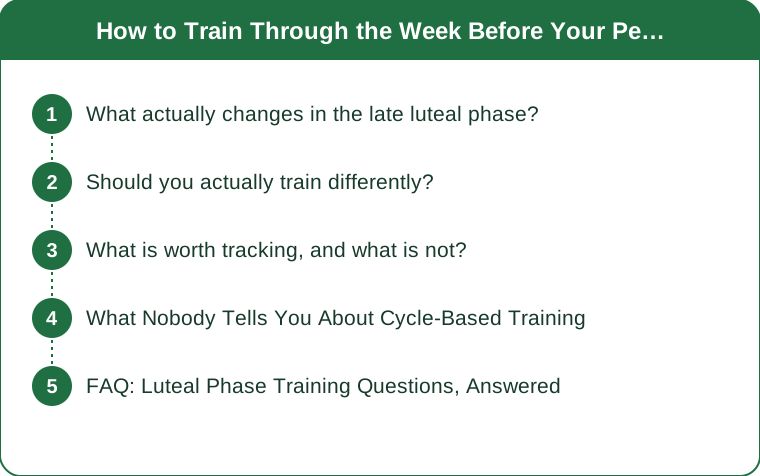
What actually changes in the late luteal phase?
Three things with reasonable research support, and a lot of individual variation on top.
Core body temperature is slightly elevated. Progesterone raises resting core temperature by roughly 0.3-0.5 degrees Celsius after ovulation. That is small, and it matters because it reduces the margin before you reach the temperature where performance declines.
In warm conditions this is the most practically relevant change. Studies on thermoregulation across the cycle generally find that heat tolerance is somewhat reduced in the luteal phase, and the sweating response may start at a slightly higher temperature threshold. A hot late-summer session is genuinely harder than the same session two weeks earlier.
Perceived effort tends to rise. Several studies have found higher ratings of perceived exertion at matched intensities in the luteal phase, even where actual performance is unchanged. This is worth knowing precisely because it decouples how a session feels from what you achieved.
Fuel use may shift. There is evidence of altered substrate utilisation across the cycle, with some research suggesting greater reliance on fat and a possible increase in carbohydrate needs for high-intensity work in the luteal phase. The findings are not uniform, and the practical version is straightforward: under-fuelling shows up more in this week.
The important caveat about all of this: effect sizes in the research are generally small, and individual variation is large. Reviews of cycle-based training research consistently note that the evidence is not strong enough to prescribe rigid phase-based programmes. Your own tracking is more useful than any general model.
What that means practically: treat these as explanations for what you notice, not as instructions about what to do. If you feel fine, train normally.
Should you actually train differently?
Adjust expectations more than programming. That distinction does most of the work.
What not to do: cancel hard sessions on principle. The evidence does not support a rigid rule that intensity should drop in the luteal phase. Plenty of people perform well throughout, and pre-emptively downgrading training based on a calendar removes sessions you were capable of doing.
What to do instead:
Keep the structure, adjust the target. If a session calls for a specific weight or pace and it feels substantially harder than usual, work to effort rather than to the number. You still did the session.
Move the hardest session if you can. If your schedule has flexibility, placing the most demanding session in a week where you consistently feel better is sensible periodisation - not because the luteal week is unusable, but because you get more out of it elsewhere.
Be more deliberate about fuelling before hard work. Under-fuelling in this week produces a disproportionate drop in quality. Eating a carbohydrate-containing meal or snack before hard sessions is the single most useful adjustment for most people.
Adjust for heat specifically. In late summer, this is the most concrete change:
- Train earlier or later in the day where possible
- Start cooler than usual - pre-cooling with a cold drink helps
- Expect a higher heart rate at the same pace and do not chase the usual number
- Increase fluid intake, particularly for longer sessions
On strength training specifically: there is no consistent evidence that strength declines in the luteal phase, though perceived effort may rise. Autoregulating by using a rep-in-reserve approach rather than fixed percentages handles the variability neatly.

What is worth tracking, and what is not?
Track little, over a long period, and look for your own pattern.
What is actually useful:
- Cycle day - the anchor for everything else
- A single subjective energy or readiness score, 1-5, taken at the same time daily
- Session quality - did it go as planned, easier, or harder
- Sleep quality, roughly
That is enough. Three cycles of this data will tell you more about your own pattern than any general model, and the whole thing takes fifteen seconds a day.
What is not worth tracking: detailed symptom inventories, precise hormone estimates from apps, or anything that takes long enough that you stop doing it. The value comes from consistency over months, so the entry has to be trivially easy.
What to look for after three cycles:
- Do hard sessions consistently feel worse on particular cycle days?
- Is there a pattern in sleep?
- Do the patterns repeat, or was one cycle unusual?
The honest expectation: many people find a clear personal pattern, and many find that other factors - sleep, work stress, training load - dominate. Both results are useful. Discovering that your cycle is not the main variable saves you from adjusting training for something that is not driving it.
One important framing point: tracking is for information, not for permission. The purpose is to explain what you notice and plan around it where convenient - not to generate rules about what you are allowed to do on a given day.
What Nobody Tells You About Cycle-Based Training
Five things that get lost between the research and the app.
The research base is thinner than the confidence of the advice. Systematic reviews of cycle-phase training repeatedly note low study quality, small samples, inconsistent phase definitions and conflicting results. Anyone giving you a precise phase-by-phase programme is extrapolating well beyond what the evidence supports.
Hormonal contraception changes the entire picture. Combined hormonal contraceptives suppress the natural cycle, so phase-based frameworks built on natural cycling do not transfer directly. This is routinely ignored in cycle-training content, despite applying to a large proportion of the audience.
Cycle length variability matters more than people expect. A framework assuming a 28-day cycle misaligns quickly if yours is 31 or 26 days, and cycle length varies between cycles for many people. Tracking your own is the only way to place the phases correctly.
The luteal phase is not universally the bad one. Some people feel best in it. The framing of luteal-as-difficult comes from averages and from the symptoms that prompt people to seek information. If it is a strong week for you, that is a legitimate finding rather than an error.
Perceived effort rising without performance falling is one of the most useful things to know. It means that on a day where everything feels harder, the actual output may be unchanged. That knowledge alone stops a lot of unnecessary session-abandoning.
FAQ: Luteal Phase Training Questions, Answered
Should I skip hard workouts the week before my period?
Not as a rule. Adjust targets to effort rather than to fixed numbers, and move the hardest session if your schedule allows. Pre-emptively cancelling based on the calendar removes training you were capable of.
Why do I feel so much hotter training in this week?
Core temperature is slightly elevated after ovulation, which reduces the margin before heat starts affecting performance. In warm weather this is the most practically noticeable change - training earlier, drinking more and starting cooler all help.
Do I need more carbohydrate in the luteal phase?
Possibly, particularly around high-intensity sessions - the research is suggestive rather than conclusive. What is clearer is that under-fuelling shows up more in this week, so eating properly before hard sessions matters more than usual.
Does this apply if I am on hormonal birth control?
Mostly not in the same way. Combined hormonal contraceptives suppress the natural cycle, so natural-cycle frameworks do not transfer. Some people on contraception notice patterns tied to their pill cycle instead, and personal tracking is the way to find out.
How many cycles before I can see my pattern?
At least three, and preferably more. Single cycles vary enough that one observation is not a pattern. A simple daily 1-5 energy score alongside cycle day is enough data.
What if my symptoms are genuinely disruptive?
That is worth a conversation with a doctor rather than a training adjustment. Severe symptoms are treatable, and training around them is not the only option available.
TL;DR:
- Core temperature is slightly elevated in the luteal phase, which matters most in warm weather
- Perceived effort tends to rise at matched intensity - a session can feel harder while output is unchanged
- Keep the training structure, work to effort rather than to fixed numbers, and fuel properly before hard sessions
- The research base is thinner and more variable than most cycle-training advice implies
- Hormonal contraception changes the picture entirely and is usually ignored in this content
- Track cycle day plus one energy score for three cycles - your own pattern beats any general model
Knowing why a session feels harder is worth more than a rule about whether to do it.
Keep Reading
This article is for general informational purposes only and is not medical advice. Always consult a qualified health professional for guidance specific to you.