Why Your Follicular Phase Workouts Feel Easier and How to Use It
Quick Answer: In the follicular phase, rising oestrogen with low progesterone is associated with better tolerance for higher-intensity work for many people — lower resting body temperature, better carbohydrate use, and often better recovery. Use it for your harder sessions, but treat it as a personal pattern to verify rather than a rule to obey.
The subjective experience is consistent enough that most people notice it. The research is less tidy than the internet suggests, which is worth saying up front.

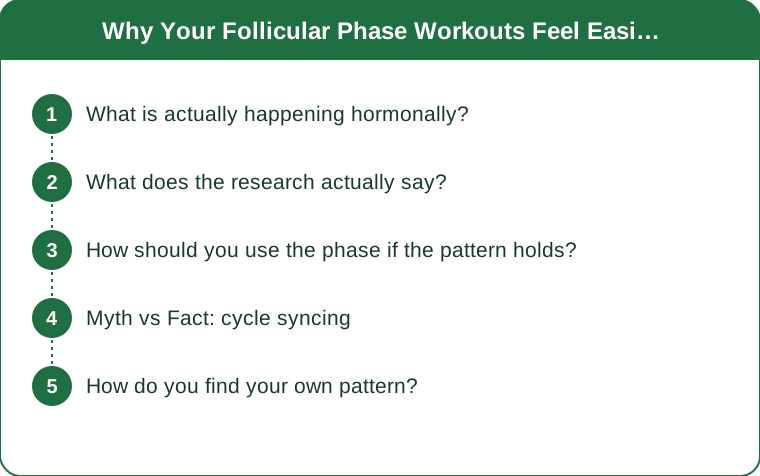
What is actually happening hormonally?
The follicular phase runs from the first day of your period until ovulation — typically days 1-14 in a 28-day cycle, though cycle length varies considerably between people and between months.
During the first few days, both oestrogen and progesterone are low. Then oestrogen rises steadily toward a peak just before ovulation, while progesterone stays low.
The relevant physiological differences from the luteal phase:
- Lower resting core body temperature — progesterone raises it by around 0.3-0.5°C in the luteal phase, so the follicular phase starts cooler and has more thermal headroom.
- Different substrate use — some evidence suggests better carbohydrate availability and use when oestrogen is high relative to progesterone.
- Lower ventilation rate at a given workload compared with the luteal phase, where progesterone increases breathing drive.
Those are real, measurable differences. Whether they translate into meaningfully better performance is where it gets complicated.
What does the research actually say?
Less definitively than most cycle-syncing content implies, and it is worth being honest about that.
Systematic reviews of exercise performance across the menstrual cycle have generally concluded that performance may be trivially reduced during the early follicular phase compared with other phases, but that the quality of the evidence is low and the between-study variation is high.
The practical problems with this research are substantial: small sample sizes, inconsistent methods for confirming cycle phase, wide individual variation, and the fact that most studies do not account for hormonal contraception, which changes the picture entirely.
What that means practically: the group-average effect is small and uncertain. The individual effect can still be large and real for you. Those two statements are not contradictory, and holding both is the useful position.
So the sensible approach is not to follow a prescribed template, but to track your own pattern and plan around what you actually find.

How should you use the phase if the pattern holds?
If you consistently feel stronger in the follicular phase, structure around it:
Days 1-5 (menstruation): Many people feel worse in the first day or two and noticeably better by day three or four. Keep this flexible. Light movement often helps symptoms rather than worsening them.
Days 6-14 (mid-to-late follicular): This is where to place the demanding work if your pattern supports it.
- Heavy strength sessions. Your top sets, your PR attempts.
- High-intensity intervals. Better thermal headroom and carbohydrate availability both favour this.
- Skill and technique work. Some people report better coordination; the evidence here is thin, but it costs nothing to schedule it here.
- Progressive overload weeks. If you run training blocks, aligning the heaviest week here is a reasonable experiment.
The caution: do not schedule so much into two weeks that you cannot recover. The follicular phase feeling good is not the same as being able to absorb double the training load.
Myth vs Fact: cycle syncing
Myth: Everyone follows the same pattern. Fact: Individual variation is one of the most consistent findings in this literature. Some people feel strongest in the luteal phase. Your pattern is data; a template is a guess.
Myth: You should avoid hard training during your period. Fact: Many athletes train and compete well throughout. Exercise can also reduce cramping for some people. If you feel fine, train.
Myth: Cycle syncing works the same on hormonal contraception. Fact: Most hormonal contraceptives suppress the natural hormonal fluctuation, so the phases as described do not apply in the same way. Much cycle-syncing advice quietly ignores this.
Myth: The research strongly supports phase-based programming. Fact: It does not, yet. The mechanisms are real; the performance evidence is low-certainty. Track rather than assume.
Myth: If you do not feel a difference, you are not paying attention. Fact: Plenty of people genuinely have no noticeable pattern, and that is a normal result rather than a failure to observe.
How do you find your own pattern?
Three cycles of simple tracking gives you more useful information than any general guideline.
Track four things daily, in under a minute:
- Cycle day.
- Session RPE — how hard it felt, 1-10, regardless of what you did.
- Energy on waking, 1-5.
- One objective marker if you have it — a working weight, a pace at a set effort, or resting heart rate.
After three cycles, plot RPE against cycle day. If a pattern exists, it becomes visible; if it does not, you have saved yourself from restructuring your training around something that is not there.
Two important caveats. Cycle length varies, so ovulation is not reliably on day 14 — if you want accuracy, track it directly rather than assuming. And if your cycle is very irregular, extremely painful, or has changed noticeably, that is worth a medical conversation rather than a training adjustment. This is general information, not medical advice.
TL;DR:
- The follicular phase has lower core temperature, different substrate use, and lower ventilation than the luteal phase — real physiological differences.
- Performance research across the cycle is low-certainty with high individual variation; group averages say little about you.
- If your pattern holds, place heavy strength, intervals, and overload weeks in days 6-14.
- Hormonal contraception changes the picture substantially, and most cycle-syncing advice ignores that.
- Track cycle day, RPE, energy, and one objective marker for three cycles before restructuring anything.
The useful version of cycle syncing is personal and empirical rather than prescriptive. Three cycles of one-minute tracking tells you whether there is a pattern worth planning around, which is more than any template can offer.
Keep Reading
This article is for general informational purposes only and is not medical advice. Always consult a qualified health professional for guidance specific to you.