Can You Cycle Sync Your Workouts If Your Period Is Irregular?
Quick Answer: Cycle syncing with an irregular cycle is still possible, but it requires syncing to your actual symptoms (energy, cramping, mood) rather than a fixed day-count calendar, since day-based phase predictions become unreliable when cycle length varies — symptom-based tracking adapts automatically where calendar-based syncing doesn’t.
A lot of cycle syncing guides assume a textbook 28-day cycle with predictable phase lengths. If your actual cycle doesn’t work that way, the whole framework can feel unusable — but it doesn’t have to be.

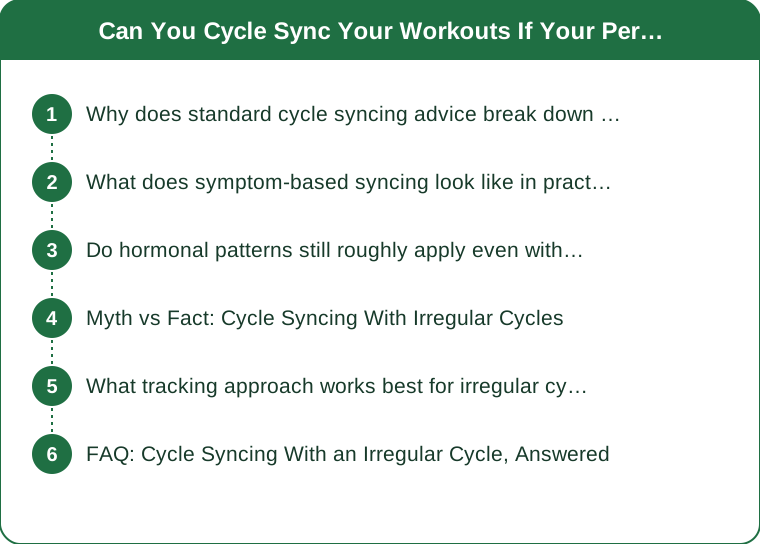
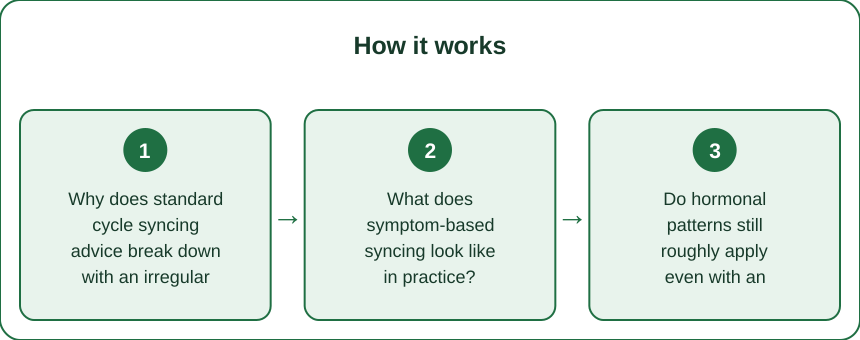
Why does standard cycle syncing advice break down with an irregular cycle?
Most cycle syncing frameworks assign workout intensity recommendations to specific days of a 28-day cycle, but if your actual cycle length varies significantly month to month, those day-based predictions become inaccurate — you might be training for a phase you’re not actually in, based on a calendar that doesn’t reflect your body.
What does symptom-based syncing look like in practice?
Instead of following a day-count calendar, symptom-based syncing means tracking energy levels, cramping, mood, and sleep quality daily and adjusting training intensity based on how you actually feel that day, which naturally adapts regardless of whether your cycle is 24 days or 35 days that particular month.
Do hormonal patterns still roughly apply even with an irregular cycle?
Generally yes — the broad hormonal pattern (lower energy around menstruation, rising energy through the follicular phase, potential dip premenstrually) still tends to hold even when cycle length is irregular, it’s just the timing that becomes less predictable. Syncing to symptoms rather than a calendar captures this pattern without needing exact day predictions.

Myth vs Fact: Cycle Syncing With Irregular Cycles
Myth: You can’t cycle sync at all without a predictable cycle. Fact: Symptom-based syncing works regardless of cycle regularity — it just requires more day-to-day attention than calendar-based syncing.
Myth: An irregular cycle always means something is medically wrong. Fact: Cycle irregularity has many normal causes, though persistent irregularity is worth discussing with a doctor.
What tracking approach works best for irregular cycles specifically?
A simple daily log of energy level, any cramping, and mood, kept over a few months, tends to reveal your personal pattern even without a predictable day count — some people find their symptoms cluster consistently even when the exact days shift, which is enough information to sync training intensity to.
FAQ: Cycle Syncing With an Irregular Cycle, Answered
Should you see a doctor about cycle irregularity before trying to sync workouts?
If irregularity is new, significant, or accompanied by other symptoms, checking with a doctor first is a reasonable step.
Does symptom-based syncing take longer to feel useful than calendar-based syncing?
It can take a few months of tracking to notice your personal pattern, compared to calendar syncing which gives immediate (if less accurate) predictions.
Can period tracking apps still help with an irregular cycle?
Yes, especially apps that let you log symptoms directly rather than relying purely on day-count predictions. This is general information, not medical advice.
TL;DR:
- Day-count cycle syncing becomes unreliable with an irregular cycle
- Symptom-based tracking (energy, cramping, mood) adapts automatically
- Broad hormonal patterns often still apply even when exact timing doesn’t
- A few months of daily symptom logging reveals your personal pattern
If calendar-based cycle syncing hasn’t worked for you, try switching to daily symptom tracking instead — it’s more effort upfront but adapts to your actual body.
Keep Reading
This article is for general informational purposes only and is not medical advice. Always consult a qualified health professional for guidance specific to you.