How Much Should Workout Intensity Actually Change Across Your Cycle?
Quick Answer: The clearest evidence-supported adjustment is during the luteal phase and menstruation, where some people experience reduced strength output and higher perceived exertion — a modest 10-20% intensity or volume reduction, not a full stop, tends to match what most people report needing.
Cycle syncing content often gives vague direction — ‘take it easier’ during certain phases — without specifying how much easier, which leaves people either over-restricting on good days or pushing through on days their body is signaling otherwise.
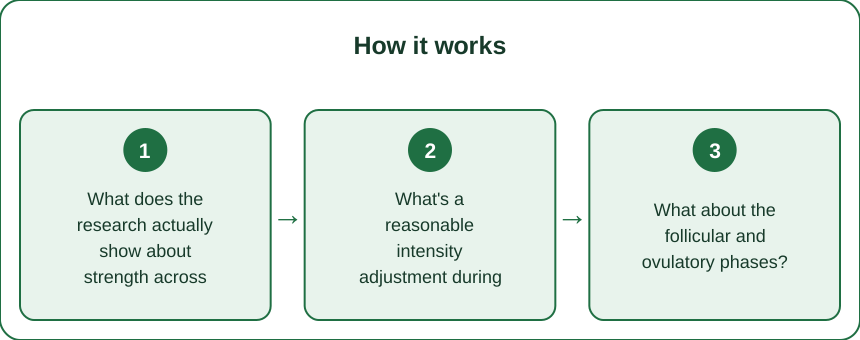
What does the research actually show about strength across the cycle?
Research findings are mixed and individual variation is significant, but several studies suggest modestly higher perceived exertion during the late luteal phase and first days of menstruation for some people, even at the same actual workload — meaning the same weight can feel harder without necessarily being physiologically weaker.
This is a meaningfully different claim than ‘you’re weaker’ during these phases — the evidence points more toward perceived effort and comfort changing than raw strength capacity dropping dramatically for most people.
What’s a reasonable intensity adjustment during the luteal phase and period?
A 10-20% reduction in either load or volume — not skipping training — tends to match what most people who track this report as needed. That could mean the same exercises at a slightly lighter weight, or the same weight for fewer total sets.
This is a starting point to adjust from based on your own tracked experience, not a fixed prescription — some people notice no difference at all and don’t need to adjust anything.
What about the follicular and ovulatory phases?
Some research suggests slightly improved strength and recovery capacity during the follicular phase (after the period ends, before ovulation) for some individuals, which is part of why several cycle-syncing programs suggest scheduling higher-intensity or PR-attempt sessions here.
The evidence for this is less robust than commonly presented in popular content — it’s a reasonable pattern to test for yourself, not a guarantee that will apply to your specific body.
How should someone actually test this for themselves?
Track perceived exertion (a simple 1-10 scale) alongside your actual training log for 2-3 full cycles, noting cycle day and phase alongside each session. Patterns — or lack of them — should emerge within that window.
Some people find a clear, consistent pattern worth planning around; a substantial number find little meaningful difference and are better served training by feel session-to-session rather than pre-planning around cycle phase.
FAQ: Cycle and Training Intensity Questions, Answered
Do irregular cycles make this kind of tracking pointless?
Not pointless, just less predictable for phase-based planning — training by daily perceived exertion works regardless of cycle regularity and is a reasonable fallback if phase tracking isn’t reliable for you.
Is it bad to do high-intensity training during your period?
Not inherently — many people train at full intensity through their period without issue; the adjustment is about individual comfort and perceived exertion, not a universal restriction.
Does hormonal birth control change how much cycle phase affects training?
Likely yes for many users, since hormonal contraception flattens some of the natural hormone fluctuation that cycle-syncing theories are based on — this is part of why cycle syncing advice may apply less directly to hormonal birth control users.
TL;DR:
- Evidence points to changes in perceived exertion more than dramatic strength loss for most people
- A 10-20% intensity or volume reduction during luteal phase/period is a reasonable starting adjustment, not a mandate
- Follicular phase may suit higher-intensity sessions for some, but evidence here is less robust
- Track exertion alongside cycle day for 2-3 cycles to see if a real pattern exists for you specifically
Keep Reading
This article is for general informational purposes only and is not medical advice. Always consult a qualified health professional for guidance specific to you.