Cycle Syncing Workout Intensity: What to Actually Change Phase to Phase
Quick Answer: Workout intensity generally trends lowest during your period (light movement, walking, gentle yoga), rises through the follicular phase as energy and strength capacity increase, peaks around ovulation for the heaviest lifting or hardest cardio, then gradually tapers through the luteal phase as recovery demands increase — the shift is gradual, not a hard switch between four rigid boxes.
Most cycle syncing content tells you what to do on any given day but skips the actual mechanism — why intensity capacity changes, and how much it really shifts from one week to the next.

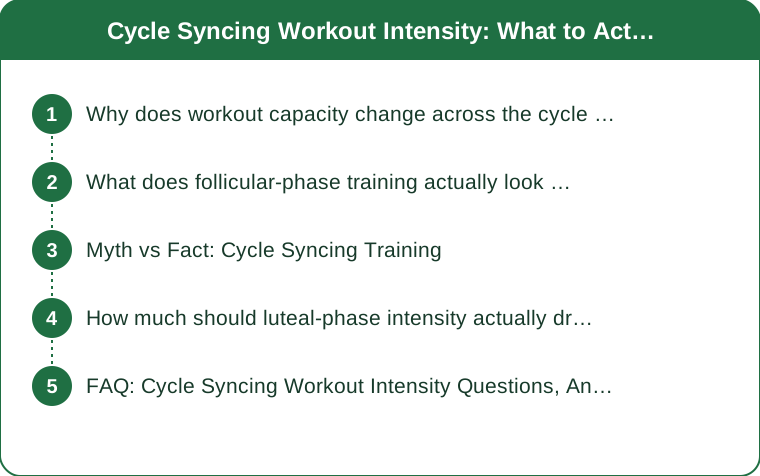
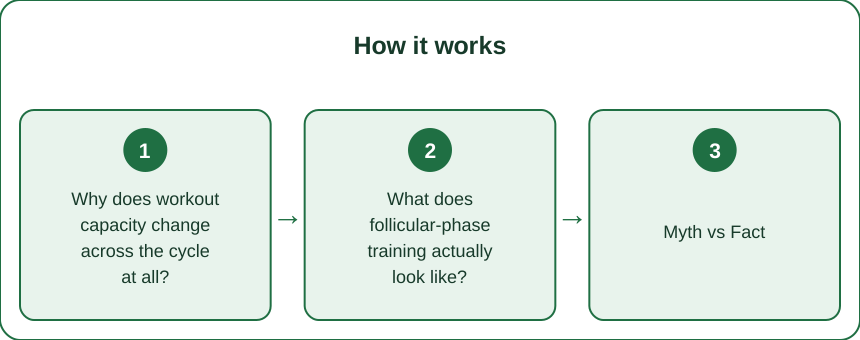
Why does workout capacity change across the cycle at all?
Estrogen and progesterone fluctuations affect energy availability, joint laxity, and perceived exertion, which is why the same workout that feels manageable during the follicular phase can feel notably harder during the late luteal phase — this isn’t about willpower, it’s a real physiological shift in how much a given effort level costs you that day.
What does follicular-phase training actually look like?
As estrogen rises through the follicular phase, many people notice improved strength output and faster recovery between sets, making this a reasonable window to progressively add weight or push pace. A common approach: 3-4 sets of 6-8 reps at a heavier load than your period-week baseline, with normal rest (60-90s) rather than extended recovery.

Myth vs Fact: Cycle Syncing Training
Myth: you should only do gentle yoga during your period. Fact: light-to-moderate movement, including walking or easier strength work, is fine for most people and can even help with cramps — full rest isn’t required unless symptoms are severe.
Myth: ovulation is universally your strongest day. Fact: it’s a common pattern, but individual variation is real — some people feel their peak a day or two before or after ovulation, so tracking your own data matters more than a generic calendar.
Myth: luteal-phase fatigue means you shouldn’t train at all. Fact: shifting toward moderate intensity and shorter sessions usually works better than stopping entirely, since consistency still matters for the follicular-phase gains to hold.
How much should luteal-phase intensity actually drop?
Rather than a dramatic cut, most people do well reducing top-end intensity by roughly 10-20% — trading a heavy 5-rep set for a moderate 10-12 rep set, or swapping one high-intensity interval session for steady-state cardio — while keeping training frequency roughly the same.
FAQ: Cycle Syncing Workout Intensity Questions, Answered
Do I need to track my cycle for months before this actually works?
A rough sense of your own pattern over 2-3 cycles is more useful than a rigid four-phase template applied blindly from day one — everyone’s pattern shifts slightly.
Is it bad to lift heavy during my period if I feel fine?
No — if energy and comfort allow it, there’s no strong reason to avoid heavier training during your period specifically; the phase-based guidance is a general tendency, not a hard rule.
Does hormonal birth control change how this applies?
Yes, largely — hormonal contraceptives suppress the natural fluctuation this approach is built around, so cycle syncing in this sense applies less directly; tracking your own energy patterns still helps regardless.
TL;DR:
- Intensity capacity shifts gradually across the cycle, driven by real hormonal changes, not just mood
- Follicular phase (post-period through ovulation) tends to support the heaviest training
- Luteal-phase intensity drops modestly (10-20%), not to a full stop
- Your own tracked pattern matters more than a generic four-phase calendar
Cycle syncing works best as a loose guide you adjust to your own data, not a rigid schedule applied the same way to everyone.
Keep Reading
This article is for general informational purposes only and is not medical advice. Always consult a qualified health professional for guidance specific to you.