How to Cycle Sync Your Workouts When Your Work Schedule Is Never the Same
Quick Answer: Track your phase, not your calendar days, and keep a flexible 2-tier workout plan per phase (a full version and a 15-minute version) so whichever hours you get, you match intensity to where you actually are in your cycle, not to a fixed weekly schedule.
Most cycle syncing advice assumes a predictable Monday-Friday routine, and shift work or rotating hours makes that framework feel useless fast. The phase-matching logic still works — it just needs a different structure around it.

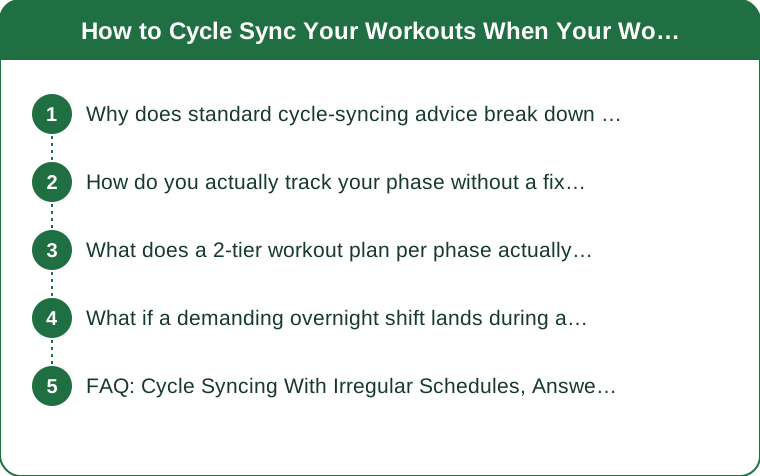
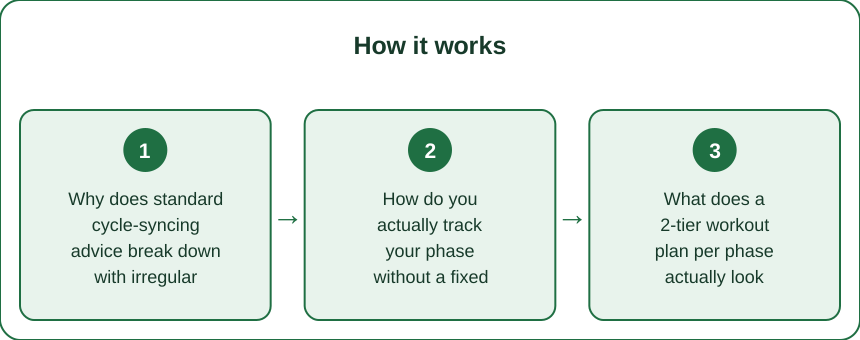
Why does standard cycle-syncing advice break down with irregular hours?
Most guides map specific workout types to specific days of the week, assuming a stable schedule where Monday is always a rest day and Thursday is always high-intensity. Irregular schedules make day-of-week irrelevant — what matters is which cycle phase you’re in when you actually have a window to train, regardless of what day that falls on.
How do you actually track your phase without a fixed calendar?
A period-tracking app that predicts phase by cycle day (not calendar day) lets you check “what phase am I in today” independent of your work schedule. Check it the morning of, or the night before, whatever shift you’re working — the phase doesn’t change based on when you’re free to train.

What does a 2-tier workout plan per phase actually look like?
Follicular/ovulation phase (higher energy): full version = a 45-minute strength or HIIT session; 15-minute version = a shorter, still-intense circuit for tight windows. Luteal/menstrual phase (lower energy): full version = a 30-minute moderate strength or steady cardio session; 15-minute version = gentle mobility or a short walk. Having both ready means any available time slot has a phase-appropriate option, not just an all-or-nothing choice.
What if a demanding overnight shift lands during a high-energy phase?
Prioritize sleep recovery over hitting the “ideal” workout for that phase — a high-energy phase doesn’t override the real fatigue of disrupted sleep from shift work. The phase-matched plan is a guide for available energy, not a mandate to push hard regardless of how depleted shift work has left you that day.
FAQ: Cycle Syncing With Irregular Schedules, Answered
Does cycle syncing still work if I can’t train the same time each phase?
Yes — the phase-to-intensity matching is what matters, not consistent timing; flexibility in timing doesn’t undo the benefit.
How do I track my cycle if my sleep schedule keeps my body clock shifting?
Most apps track by calendar date and symptoms rather than sleep timing, so cycle tracking itself isn’t disrupted by shift work the way sleep and hormones might feel disrupted.
Should shift workers expect cycle syncing to work as well as people with regular schedules?
Generally close, though shift work’s own effects on hormones and sleep are a separate factor worth discussing with a doctor if cycles become notably irregular.
TL;DR:
- Track phase by cycle day, not calendar day or work schedule
- Keep a full and a 15-minute version of workouts ready for each phase
- Match intensity to phase whenever you have a window, regardless of day of week
- Sleep recovery takes priority over an “ideal” workout after a demanding shift
Keep Reading
This article is for general informational purposes only and is not medical advice. Always consult a qualified health professional for guidance specific to you.