Cycle Syncing When You're Traveling Across Time Zones — What Actually Shifts
Quick Answer: Crossing time zones can shift ovulation or your period by 1-3 days due to disrupted sleep and cortisol, not because your cycle is broken. Track by symptoms rather than the calendar for the trip, and expect a return to baseline within one full cycle.
You’ve matched your workouts to your follicular and luteal phases for months, and then a long flight throws the whole map off by a few days. That’s not a failure of cycle syncing — it’s a predictable, temporary wobble.
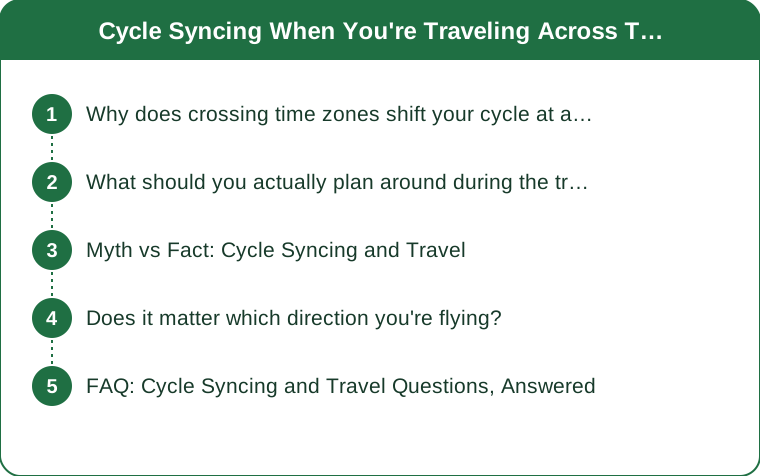
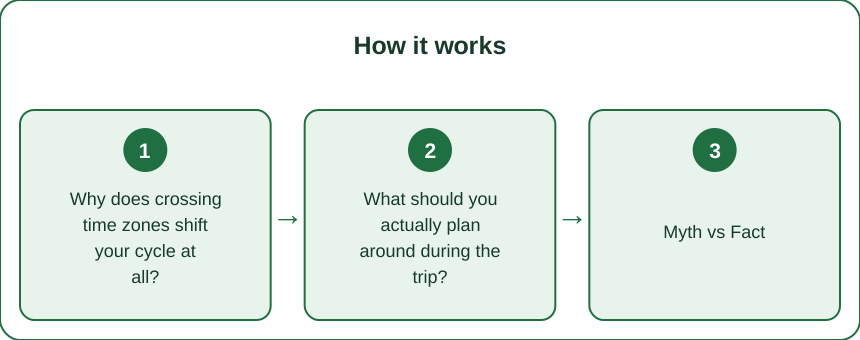
Why does crossing time zones shift your cycle at all?
Your cycle is partly regulated by circadian rhythm, and cortisol and melatonin disruption from jet lag can delay or nudge ovulation timing by a few days in either direction.
This is more noticeable on long-haul flights (5+ time zones) than short regional trips, and it’s usually temporary rather than a lasting disruption.
What should you actually plan around during the trip?
Symptoms over the calendar — bloating, energy dips, and mood shifts are more reliable than a date prediction when your internal clock is scrambled.
Pack for a wider window than usual (a few extra days of supplies) and lower workout intensity expectations for the first 2-3 days post-flight, regardless of what phase the calendar says you’re in.

Myth vs Fact: Cycle Syncing and Travel
Myth: A shifted cycle after travel means something is wrong. Fact: A 1-3 day shift from time zone changes is common and typically self-corrects within a cycle or two.
Myth: You should force your usual phase-based workout plan regardless of jet lag. Fact: Fatigue from travel compounds with any luteal-phase tiredness — scaling back for 2-3 days is realistic, not a setback.
Myth: Ovulation predictor kits are unreliable while traveling. Fact: They still work, but test slightly more often since the exact day may shift.
Does it matter which direction you’re flying?
Eastward flights (losing time) tend to disrupt circadian rhythm more than westward flights (gaining time), which can mean a slightly more noticeable cycle shift after flying east.
Either direction, the fix is the same: prioritize sleep recovery over forcing a phase-specific routine for the first few days.
FAQ: Cycle Syncing and Travel Questions, Answered
Can travel actually delay ovulation?
Yes — disrupted sleep and stress hormones from jet lag can delay ovulation by several days in some cycles, especially after long-haul flights.
Should I still take my supplements on the new time zone’s schedule?
Shifting gradually over 1-2 days to the new local time is usually easier than an abrupt switch, especially for anything tied to meals.
Will my cycle length change permanently after one trip?
A single trip’s disruption is typically temporary; it’s worth tracking two cycles after to confirm you’ve returned to your normal baseline.
TL;DR:
- Time zone changes can shift ovulation or period timing by 1-3 days via cortisol and circadian disruption
- Track by symptoms, not the calendar, for the trip itself
- Eastward flights tend to disrupt rhythm more than westward
- Expect a return to baseline within one to two cycles
A scrambled cycle after a flight isn’t a sign something’s wrong — it’s your body’s clock catching up, same as your sleep does.
Keep Reading
This article is for general informational purposes only and is not medical advice. Always consult a qualified health professional for guidance specific to you.