Can You Cycle Sync If Your Period Is Irregular and You Don't Know Your Length?
Quick Answer: Yes — instead of syncing to calendar days, track symptoms (energy, cramping, discharge changes) for 2-3 cycles to identify your personal phase signals, then sync workouts and food to how you feel that day rather than to a fixed day count.
Most cycle-syncing guides assume you can predict day 14 with confidence. If your cycle swings between 24 and 40 days, that math falls apart fast — but the underlying idea still works once you switch what you’re tracking.

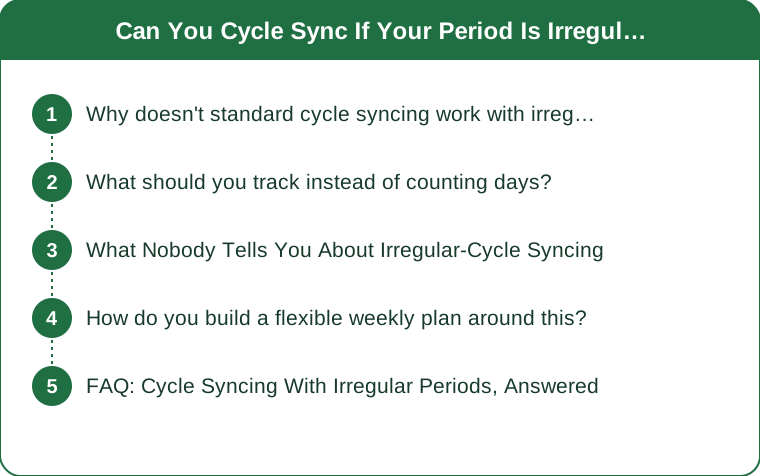
Why doesn’t standard cycle syncing work with irregular cycles?
Standard guides map specific workouts to specific calendar days (‘day 1-5: rest,’ ‘day 14: ovulation’), which assumes a textbook 28-day cycle. If your actual length varies by more than a week cycle to cycle, those day numbers stop lining up with what’s actually happening in your body.
The fix is switching from day-based to symptom-based tracking — your body gives real-time signals regardless of how predictable the calendar is.
What should you track instead of counting days?
- Energy level (1-10) each morning
- Cramping or pelvic heaviness
- Cervical fluid changes (a reasonably reliable ovulation signal even in irregular cycles)
- Sleep quality and mood
After 2-3 cycles of this, patterns usually emerge even without a predictable length — most people notice their own low-energy stretch and high-energy stretch regardless of exact timing.

What Nobody Tells You About Irregular-Cycle Syncing
Ovulation predictor kits or basal body temperature tracking work independently of cycle length — they detect the hormonal shift itself, not a day count, making them more reliable for irregular cycles than any calendar-based app.
Also underrated: persistent irregularity (consistently under 21 or over 35 days, or big unexplained swings) is worth a conversation with a doctor — cycle syncing is a wellness tool, not a diagnostic one, and it shouldn’t replace checking in on the cause.
How do you build a flexible weekly plan around this?
Keep 2 workout templates ready — a lower-intensity one (walking, mobility, light strength) and a higher-intensity one (harder lifting, intervals) — and pick between them each morning based on your tracked energy score rather than a pre-set calendar.
This removes the guesswork of ‘what day am I on’ entirely and replaces it with ‘how do I actually feel today,’ which works whether your cycle is 24 days or 40.
FAQ: Cycle Syncing With Irregular Periods, Answered
Can apps still help if my cycle is unpredictable?
Some apps that use symptom input (not just day-counting) adapt reasonably well — look for one that asks about symptoms daily rather than one that only asks for your last period start date.
How long does it take to see a pattern this way?
Most people notice a repeatable energy pattern within 2-3 tracked cycles, even without a fixed length.
Should I see a doctor about irregular cycles before trying this?
If your cycles are consistently very short, very long, or accompanied by severe symptoms, yes — get that checked first. This is general information, not medical advice.
TL;DR:
- Irregular cycles break day-based syncing — switch to symptom-based tracking instead
- Track energy, cramping, and fluid changes for 2-3 cycles to find your personal pattern
- Ovulation kits and BBT tracking work regardless of cycle length
- Keep 2 flexible workout templates and choose daily based on how you feel
This is general information, not medical advice — persistent irregularity is worth a doctor’s input.
Keep Reading
This article is for general informational purposes only and is not medical advice. Always consult a qualified health professional for guidance specific to you.