Cycle Syncing vs Progressive Overload — How to Do Both Without Stalling
Quick Answer: They only conflict if you measure progress week to week. Run progressive overload on a four-week cycle-length block instead — push loads in the follicular and ovulatory phases, hold or reduce volume (not intensity) in the late luteal, and compare each phase to the same phase last month. Your numbers keep climbing; they just climb in a wave instead of a straight line.
You finally got serious about lifting, and then you read that you should back off for a week every month.
Those two ideas seem to cancel each other out. They do not — but only if you stop judging progress on a seven-day window.

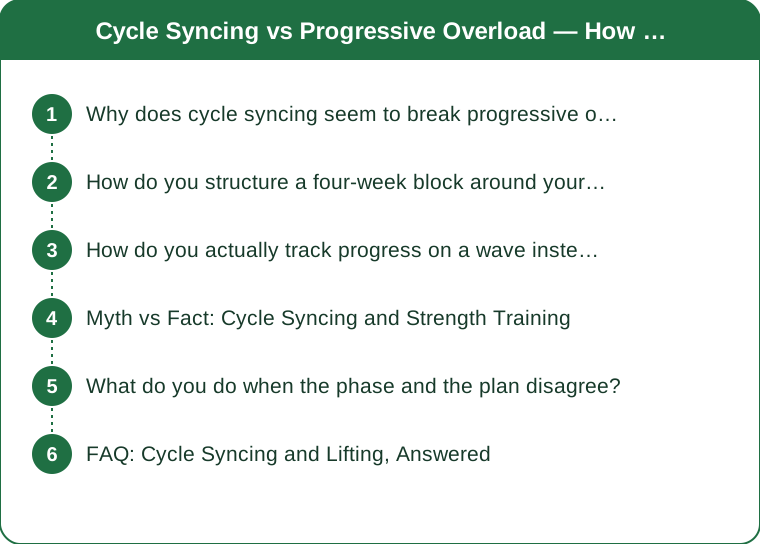
Why does cycle syncing seem to break progressive overload?
Progressive overload is the one non-negotiable of strength training: to get stronger, the demand has to keep increasing. More weight, more reps, more sets, better control — something has to go up over time.
Most programs express that as weekly increases, because a week is a convenient unit. Add five pounds to your squat every Monday. Add a rep every session. The whole mental model assumes a flat, repeatable baseline.
Your physiology does not offer a flat baseline. Across a typical 28-day cycle, body temperature, resting heart rate, joint laxity, carbohydrate availability, and perceived exertion all shift. The same 135-pound squat genuinely feels different on day 8 than on day 25 — not because you are weaker, but because the cost of producing that force changed.
So the conflict is not really between two training philosophies. It is between a weekly measurement window and a monthly biological rhythm. Compare week 4 to week 3 and it looks like you regressed. Compare week 4 to last month’s week 4 and you often see a clean gain.
The fix is a change of measuring stick, not a change of goal.
How do you structure a four-week block around your cycle?
Treat one full cycle as one training block. Here is the structure that keeps overload intact.
Week 1 — menstrual phase. Volume: moderate. Intensity: your call. Hormones are at their lowest and most stable here, which for many people means lifting feels surprisingly normal by day 3 or 4. Do not automatically program a deload. Start moderate, and if energy is there, treat it as a normal training week.
Week 2 — follicular phase. Volume: high. Intensity: high. This is your build week. Rising estrogen supports work capacity and recovery. This is where you set the new load anchors — the numbers you will try to match or beat next month. If you are going to attempt a personal record, attempt it here.
Week 3 — ovulatory. Volume: high. Intensity: peak, with a caveat. Peak strength often shows up right around ovulation. It is also the window where joint laxity is highest, so prioritize technical quality on heavy singles and be conservative with maximal attempts on movements where form breaks down under load.
Week 4 — luteal phase. Volume: reduced 20 to 30 percent. Intensity: hold. This is the key move most people get wrong. Cut sets, not weight. Keeping the load high preserves the strength stimulus and the neural adaptation; cutting volume manages the higher recovery cost and higher perceived exertion of this phase. Three sets of 5 at your working weight beats five sets of 5 at a lighter weight.
Then week 1 of the next block starts, and you compare like to like.
How do you actually track progress on a wave instead of a line?
Your training log needs one extra column: cycle day.
That single change makes the whole system work. Instead of asking “did I lift more than last week,” you ask “did I lift more than the same cycle day last month.” That is the comparison that reflects real adaptation.
What to record each session: the movement, load, sets and reps, cycle day, and a 1 to 10 rating of perceived exertion. Five seconds of writing.
What to look for after two full cycles:
- Same load, lower RPE at the same cycle day — this is progress, even if the weight did not move. It is the most common form of real improvement and the easiest to miss.
- Higher load at the matched cycle day — straightforward overload, confirmed.
- Your personal phase pattern, which may not match the textbook. Some people feel strongest in the late luteal. Some feel terrible during ovulation. The average pattern is a starting hypothesis, not a prescription.
Two full cycles is the minimum before you conclude anything. One cycle gives you a data point with no context — a bad training week could be sleep, stress, a cold, or a heavy work stretch. The pattern only shows up on repeat.
If you use hormonal birth control, the phase-based hormone swings are largely suppressed and this framework is much less relevant — train on a conventional weekly progression and use energy and sleep as your autoregulation signal instead.

Myth vs Fact: Cycle Syncing and Strength Training
Myth: You should not lift heavy during your period. Fact: There is no physiological reason to avoid heavy loading during menstruation, and many people report feeling strong by day 3. Cramps and fatigue are real reasons to modify on a given day; the calendar alone is not.
Myth: The luteal phase means a mandatory deload week. Fact: A deload is a planned reduction in total stress, and it is useful roughly every 4 to 8 weeks depending on training load — not automatically every month. Reducing volume by 20 to 30 percent while holding intensity is a modification, not a deload.
Myth: You lose strength during the luteal phase. Fact: Measured maximal strength varies far less across the cycle than perceived exertion does. What changes most is how hard a given weight feels, and how long recovery takes afterward. That is why cutting volume works better than cutting load.
Myth: Cycle syncing means a completely different workout each week. Fact: Changing exercises every week destroys your ability to measure anything. Keep the same core lifts all month; adjust sets and recovery around them.
Myth: If your cycle is irregular, none of this applies. Fact: You can still autoregulate off symptoms rather than dates — track sleep quality, resting heart rate, and RPE, and modify volume when two of the three go the wrong direction. The calendar is a proxy for how you feel; when the calendar is unreliable, go straight to the signal.
What do you do when the phase and the plan disagree?
It happens constantly, and the answer is always the same: the body wins, the log records why.
Scenario: It is your follicular build week and you feel awful. Do the planned session at 80 percent of the planned volume, keep the loads, and note it. One bad week does not require restructuring anything. If it happens two cycles in a row on the same phase, your personal pattern is not the textbook pattern — adjust the template.
Scenario: It is your reduced-volume luteal week and you feel excellent. Take the extra work, but add sets rather than weight. Volume is easier to recover from than a new load anchor, and you do not want to set a personal record in a phase you will be comparing against for the rest of the year.
Scenario: Your cycle length shifted and the block is now 24 or 33 days. Blocks flex with the cycle. That is the entire point. Do not force a 28-day template onto a 33-day cycle — extend the follicular build and keep the luteal reduction anchored to the actual phase change.
Scenario: You are training for a competition on a fixed date. Competition prep overrides cycle syncing. Peak for the meet, and use the cycle information to plan your heaviest training sessions where possible rather than to move the meet.
One genuine caution: if you have very heavy bleeding, cycle-related fainting, pain that stops you training, or a cycle that has stopped entirely while you are training hard, that is worth a medical conversation rather than a programming tweak. Missed periods in athletes can signal low energy availability, which affects bone and long-term health. This is general information, not medical advice.
FAQ: Cycle Syncing and Lifting, Answered
Do I need an app to do this?
No. A notebook column for cycle day and a rough note of where your period started does everything an app does for this purpose. Apps help with prediction; the log is what makes the comparison possible.
What if my cycle is 35 days or highly variable?
Use phases rather than dates. Menstrual phase starts at bleeding, follicular runs until ovulation signs, and the luteal is roughly the two weeks after. The high-volume block simply gets longer on a longer cycle.
Can I still hit personal records in the luteal phase?
Yes, people do. The framework says do not plan your record attempts there, because the recovery cost is higher and the perceived effort is worse. If you feel great and the bar moves fast, take it.
How long before I know if this is working?
Two full cycles to see a pattern, three to trust it. Any conclusion from a single cycle is noise.
TL;DR: Cycle syncing and progressive overload only conflict on a weekly measuring stick.
- Use the cycle as your training block — one cycle, one block, compared to the same phase last month.
- Follicular and ovulatory phases are your build weeks. Set load anchors here.
- In the late luteal, cut volume 20 to 30 percent and hold intensity. Cutting weight instead is what stalls progress.
- Add a cycle-day column to your log. Same load at a lower RPE on a matched day is real progress.
- Two full cycles minimum before you conclude anything about your personal pattern.
- The body overrides the calendar — and if you are on hormonal birth control, use a conventional weekly progression instead.
Start the column this week. In two months you will have something no generic program can give you.
Keep Reading
This article is for general informational purposes only and is not medical advice. Always consult a qualified health professional for guidance specific to you.