Why Your Sleep Changes Across Your Cycle - and What Actually Helps Each Phase
Quick Answer: Sleep is usually most disrupted in the late luteal phase, in the days before a period. Progesterone rises through the luteal phase and then drops sharply, core body temperature runs roughly 0.3 to 0.5C higher, and both changes fragment sleep. The most effective interventions are temperature-focused - a cooler room, lighter bedding and an earlier evening wind-down - rather than more sleep hygiene rules.
If your sleep falls apart for four or five nights every month at the same point in the cycle, that is a pattern with a mechanism, not a personal failing.
This is general information rather than medical advice.

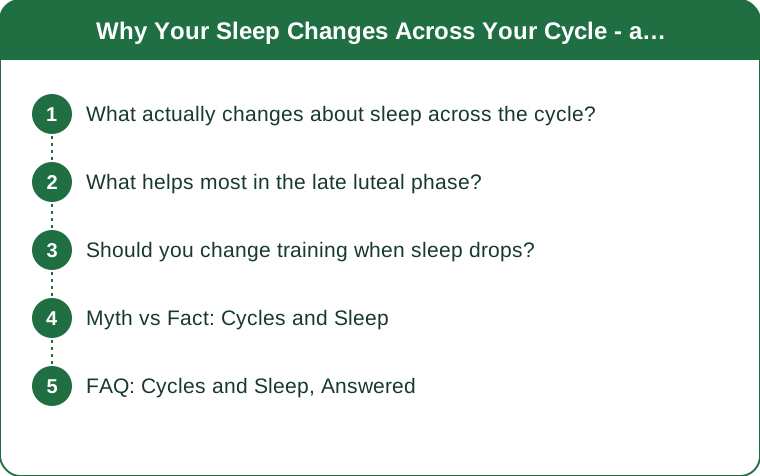
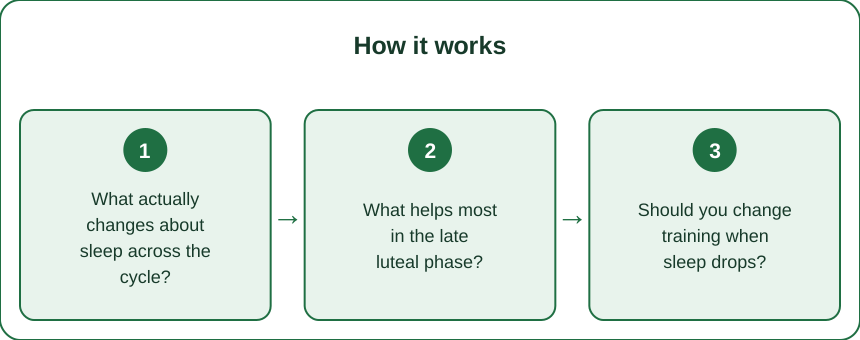
What actually changes about sleep across the cycle?
Three measurable things, and they mostly track the luteal phase.
Core body temperature. After ovulation, progesterone raises basal body temperature by roughly 0.3 to 0.5 degrees Celsius, and it stays elevated until just before menstruation. Falling core temperature is one of the signals that initiates sleep, so a persistently higher baseline makes falling asleep harder and makes the night feel warmer.
Progesterone itself. Progesterone has metabolites with sedative-like effects, which is why some people feel sleepier in the mid-luteal phase. Then it falls steeply in the late luteal phase, and that withdrawal is associated with the fragmented sleep and early waking many people report in the days before their period.
Sleep architecture. Research using sleep laboratory measures has found modest but consistent shifts across the cycle - changes in the proportion of REM sleep and in sleep efficiency, generally in the direction of poorer sleep during the late luteal phase.
The typical phase pattern that people report:
- Menstrual phase: often poor for the first day or two, driven by cramping and discomfort rather than hormones directly. Frequently improves noticeably from day 3
- Follicular phase: usually the best sleep of the cycle. Temperature is lower, hormones are relatively stable
- Ovulation: generally good, though some report a night or two of lighter sleep
- Early to mid luteal: often sleepier during the day, sometimes with more awakenings at night
- Late luteal: the worst window for most people - hard to fall asleep, waking at 3 or 4am, waking hot
One important caveat. Individual variation is substantial, and cycles vary. Tracking your own sleep against your own cycle for two to three months tells you more than any general pattern, and it takes about ten seconds per day.
What helps most in the late luteal phase?
Temperature first, because temperature is the mechanism with the clearest evidence.
Cool the sleep environment specifically for these nights:
- Drop the room by 2 to 3 degrees compared to your usual setting. If your bedroom is normally 19C, take it to around 17C for the pre-period window
- Swap to lighter bedding, or use a lighter duvet layer that you can add to rather than remove
- A warm shower 60 to 90 minutes before bed works counterintuitively well - the peripheral vasodilation afterward accelerates core temperature drop
- Cool the extremities. Feet out of the covers, or a cool compress on the wrists, both promote heat loss
Adjust the evening timeline:
- Move the wind-down 30 minutes earlier for these nights specifically. Falling asleep takes longer, so start earlier rather than lying in bed frustrated
- Finish eating earlier, since digestion raises core temperature
- Reduce evening alcohol, which fragments sleep in the second half of the night - the same half already vulnerable in this phase
On caffeine. Some people report increased caffeine sensitivity in the luteal phase. Moving your cutoff two hours earlier for the late luteal week is a cheap experiment and frequently helps.
On the 3am waking specifically. Waking in the early hours during the late luteal phase is extremely common. The most useful response is to not fight it - get out of bed after about 20 minutes, keep the lights low, do something boring, and return when sleepy. Lying awake trying to sleep trains an association between bed and frustration that outlasts the cycle phase.
What to lower expectations about: you are unlikely to make these four or five nights as good as your follicular sleep. The realistic goal is losing 30 minutes rather than two hours.

Should you change training when sleep drops?
Yes, but less dramatically than most cycle syncing advice suggests.
What the evidence actually supports. Research on cycle phase and performance is genuinely mixed - many studies find small or inconsistent effects on strength and endurance across phases. The stronger and more consistent effect is on perceived exertion and recovery quality, not on raw capacity.
Which points to a practical rule. Rather than scheduling training by cycle phase in advance, adjust based on how you actually slept. Sleep quality is the mediator, and it is measurable each morning without any cycle knowledge at all.
A workable framework:
- Slept well: train as planned regardless of phase
- One poor night: train as planned, but reduce top-end intensity and expect it to feel harder
- Two or more consecutive poor nights: keep the session, reduce the load by 10 to 20 percent, and cut the volume
- Four or more poor nights: prioritize easy aerobic work and sleep, and return to intensity afterward
Why this beats phase-based scheduling. Cycles vary in length, ovulation timing shifts, illness and travel interfere, and hormonal contraception changes the picture entirely. A rule based on last night’s sleep works in all of those cases, while a calendar-based plan breaks in most of them.
What is worth scheduling by phase. Not intensity, but the things that are genuinely easier to move: big skill-learning sessions, key testing sessions, and anything requiring sustained concentration. Putting those in the follicular phase where sleep is typically best is low-cost and sensible.
On the heat interaction. Late summer training in the late luteal phase combines a higher core temperature with a hot environment. Thermoregulation is measurably harder in the luteal phase, so heat sessions in that window warrant more caution, earlier timing, and more fluid than usual.
Myth vs Fact: Cycles and Sleep
Myth: Bad sleep before your period is psychological. Fact: Core body temperature rises with progesterone and falling temperature is a sleep-onset signal. There is a straightforward physiological mechanism.
Myth: You should sleep more in every phase of the luteal. Fact: Early luteal often brings daytime sleepiness while late luteal fragments night sleep. They are different problems needing different responses.
Myth: If cycle syncing does not fix your sleep, you are doing it wrong. Fact: Cycle-related sleep disruption is a real physiological effect that can be reduced but not eliminated. Expecting to erase it sets up unnecessary frustration.
Myth: Hormonal birth control removes the pattern. Fact: It changes it substantially and unpredictably. Combined pills flatten the natural hormone fluctuation, so many people lose the pattern entirely - but some report new patterns tied to the pill schedule. This is the single biggest reason generic cycle syncing advice fails for so many people who are following it faithfully.
Myth: Waking at 3am means something is wrong. Fact: Early-hours waking in the late luteal phase is extremely common and typically resolves when the period starts. Persistent insomnia across all phases is a different question worth raising with a doctor.
Myth: You can train through it if you are disciplined enough. Fact: You can train through it, and the useful adjustment is intensity rather than presence. Reducing load on poorly-slept days is not a lack of discipline; it is the correct response to a reduced recovery state.
FAQ: Cycles and Sleep, Answered
Why do I sleep worse before my period?
Progesterone raises core body temperature by roughly 0.3 to 0.5C and then drops sharply in the late luteal phase. Both the elevated temperature and the hormone withdrawal disrupt sleep onset and continuity.
Which phase has the best sleep?
For most people the follicular phase, after the period ends and before ovulation. Temperature is lower and hormone levels are relatively stable.
What is the single most effective thing to change?
Room temperature. Drop it 2 to 3 degrees for the pre-period nights and use lighter bedding you can add to rather than remove.
Should I skip workouts in the luteal phase?
No. Adjust based on how you slept rather than which phase you are in - reduce intensity after poor nights, train normally after good ones.
Does this happen on hormonal birth control?
Often not, or differently. Combined hormonal contraception flattens the natural fluctuation, so the pattern usually changes or disappears.
When should I see a doctor about it?
If sleep is disrupted across all phases rather than a predictable few nights, if daytime function is significantly affected, or if premenstrual symptoms are severe enough to interfere with your life.
TL;DR:
- Sleep is typically worst in the late luteal phase, driven by higher core temperature and a sharp progesterone drop
- Follicular phase sleep is usually the best of the cycle
- Temperature interventions do the most work: cooler room, lighter bedding, a warm shower 60 to 90 minutes before bed
- Adjust training by how you slept last night rather than by calendar phase - the rule survives irregular cycles and travel
- Hormonal contraception usually changes or removes the pattern, which is why generic advice often does not fit
Track sleep against your own cycle for two or three months. Your pattern is more useful than anyone’s general one.
Keep Reading
This article is for general informational purposes only and is not medical advice. Always consult a qualified health professional for guidance specific to you.