Why Motivation Disappears in the Same Week Every Month
Quick Answer: Motivation and mood shift across the cycle largely with oestrogen and progesterone. The late luteal phase - the week or so before a period - is when the drop in both hormones most commonly coincides with lower mood, lower drive, higher perceived effort, and more irritability. The practical response is not to force the same session, but to reduce decision load: pre-plan low-choice workouts for that week, lower intensity slightly, and stop interpreting the dip as a character failure.
You have a good month of training. Then one week arrives and everything feels pointless - the same session that felt fine ten days ago now feels like an imposition, and you spend the week wondering what happened to your discipline. If that week lands at roughly the same point each cycle, discipline is not what changed.

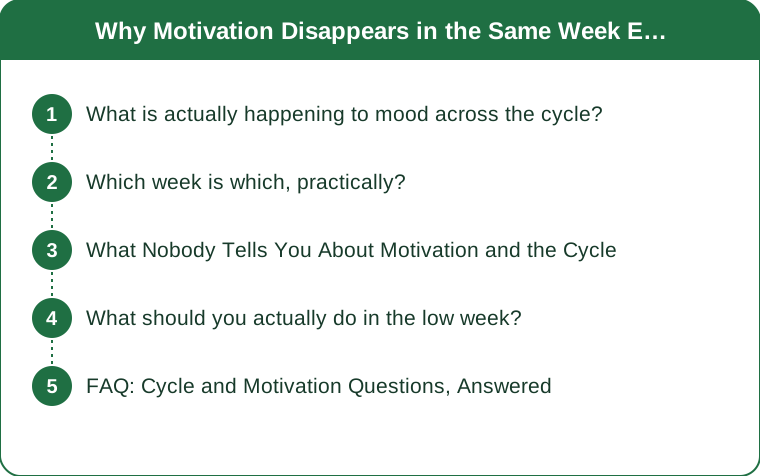
What is actually happening to mood across the cycle?
Two hormones, moving in different directions at different times, with downstream effects on neurotransmitters.
Oestrogen rises through the follicular phase, peaking around ovulation. Oestrogen has a broadly positive relationship with serotonin activity and is associated with better mood, higher pain tolerance, and greater willingness to take on effort in many people. This is why the week or so after a period often feels disproportionately capable.
Progesterone rises after ovulation through the luteal phase. Progesterone metabolites act on GABA receptors, which is broadly calming - but the relationship is not simple, and for some people this phase brings sedation, low drive, and low mood rather than calm.
Both drop sharply in the late luteal phase if pregnancy does not occur. That withdrawal - particularly the rapid fall in oestrogen - is the point most strongly associated with the mood symptoms people describe as premenstrual: irritability, low motivation, tearfulness, anxiety, and a sense that everything is harder than it was.
Sensitivity varies enormously. The hormonal pattern is broadly consistent between people; the response to it is not. Some notice almost nothing. Others experience a substantial, disruptive change - and premenstrual dysphoric disorder, a more severe form, affects a small but significant proportion of menstruating people and is a genuine medical condition rather than an intensity of ordinary experience.
Perceived effort changes even when capacity does not. This is the part most relevant to training: research on perceived exertion across the cycle suggests the same objective workload can feel harder in the luteal phase. The session did not get harder. The experience of it did. This is general information, not medical advice.
Which week is which, practically?
Mapped onto a rough 28-day cycle, counting day one as the first day of bleeding. Adjust proportionally if your cycle runs shorter or longer.
Days 1 to 5 - menstruation. Hormones are low. Mood often improves noticeably within a day or two of bleeding starting, which surprises people who expect this to be the worst week. Energy may be low from blood loss and disrupted sleep, but drive frequently returns.
Days 6 to 13 - follicular. Rising oestrogen. Typically the best week for mood, motivation, and appetite for hard sessions. This is the window to schedule anything requiring willpower - a new programme start, a hard interval block, a challenging class.
Days 14 to 16 - ovulation. Peak oestrogen, high mood and drive for many, though some experience a short dip immediately after the peak. Also the window with elevated joint laxity, which matters for landing-heavy work.
Days 17 to 24 - early to mid luteal. Progesterone rising. Often a stable but slightly heavier feeling. Steady work goes well; maximal efforts often feel harder than the numbers suggest.
Days 25 to 28 - late luteal. Both hormones falling. This is the week. Lower mood, lower motivation, higher perceived effort, worse sleep, more irritability, and more sensitivity to everything from noise to criticism.
Track it before you plan around it. Two or three cycles of noting mood and motivation on a scale of one to five each morning will tell you whether your dip lands where the textbook says, which is more useful than any general schedule.

What Nobody Tells You About Motivation and the Cycle
The dip is often about decision-making capacity, not energy. Many people in the late luteal week can complete a workout perfectly well once they start - what has collapsed is the willingness to decide, plan, change, and negotiate with themselves. This is why the most effective intervention is removing choices rather than adding motivation.
Sleep quality falls before mood does. Core body temperature is elevated in the luteal phase and sleep quality often declines measurably in the days before a period. A meaningful portion of what feels like low motivation is under-slept. Addressing the sleep does more than addressing the mindset.
Hormonal contraception changes the entire picture. Combined hormonal contraception suppresses the natural cycle, so the pattern described here may be absent, blunted, or replaced by a pattern tied to the pill-free interval. Anyone syncing to a calendar while on combined contraception is often syncing to something that is not happening.
The follicular high is as real as the luteal low and is under-used. People plan around the bad week and forget to exploit the good one. Scheduling the hardest, most novel, most willpower-intensive things into days 6 to 13 gets more from the cycle than avoiding days 25 to 28.
Perceived effort rising does not mean training is less valuable. Sessions completed in the luteal phase build fitness the same way. The subjective experience is not a measure of the physiological outcome - which is worth remembering when a run that felt terrible turns out to have been at your usual pace.
What should you actually do in the low week?
Reduce decisions, reduce intensity slightly, keep the habit.
Pre-decide everything. Before the week arrives - ideally during the follicular phase when planning feels easy - write down the exact sessions for the low week. Same time, same place, same workout, no choices. This is the highest-leverage change available and it works because it moves the decision to a week when deciding is cheap.
Lower the bar deliberately, not accidentally. A defined reduced session - 30 minutes of easy cardio, a short mobility flow, a light full-body circuit - preserves the habit without the negotiation. An undefined session becomes no session.
Swap the type, not the amount, where possible. Many people find steady-state and lower-intensity work more tolerable in this week than intervals or heavy loading. Volume can often be maintained when intensity drops.
Attend to the inputs that are actually degraded:
- Sleep - prioritise a cooler room, since core temperature is elevated.
- Food - appetite and carbohydrate cravings often increase in the luteal phase, and under-eating makes mood worse. Eating adequately is a mood intervention.
- Caffeine - sensitivity often increases; the usual afternoon coffee may be costing you sleep in exactly the week sleep is already worse.
And drop the moral framing. A predictable monthly reduction in drive is a physiological pattern, not a lapse. Treating it as evidence of weak character produces guilt, which reliably makes the mood component worse. If symptoms are severe, disruptive, or include significant depression or anxiety, that is worth a conversation with a doctor rather than a scheduling fix. This is general information, not medical advice.
FAQ: Cycle and Motivation Questions, Answered
Why do I lose all motivation the week before my period?
Oestrogen and progesterone both fall sharply in the late luteal phase, and that withdrawal is associated with lower mood, lower drive, worse sleep, and higher perceived effort. The physiological pattern is well described even though individual sensitivity varies enormously.
Should I skip workouts in my luteal phase?
Generally no - reduce rather than skip. A shorter, easier, pre-decided session preserves the habit and still builds fitness. Skipping entirely tends to make the following week harder to restart, which turns one low week into two.
Does cycle syncing work if I am on the pill?
Combined hormonal contraception suppresses the natural hormonal cycle, so the phase-based pattern largely does not apply. Some people notice a pattern tied to the pill-free week instead. Tracking your own symptoms is more useful than following a generic phase calendar.
How do I know if it is PMS or something more serious?
Severity and impact are the distinguishing factors. Symptoms that seriously disrupt work, relationships, or daily functioning, or that include significant depression, hopelessness, or anxiety, warrant medical assessment - premenstrual dysphoric disorder is a recognised condition with real treatment options. This is general information, not medical advice.
TL;DR:
- The late luteal drop in oestrogen and progesterone is when mood and drive most commonly fall.
- Perceived effort rises even when capacity does not - the session feels harder, it is not harder.
- What collapses is usually decision-making, so pre-plan that week rather than trying to summon motivation in it.
- Sleep quality falls first; a cooler room and adequate food do more than mindset work.
- Exploit the follicular window for hard, novel, willpower-heavy sessions.
The same week arriving every month is not a discipline problem. It is a pattern, and patterns can be planned around, which is considerably easier than fighting them.
Keep Reading
This article is for general informational purposes only and is not medical advice. Always consult a qualified health professional for guidance specific to you.