Why Your Luteal Phase Workouts Should Feel Easier, Not the Same as Always
Quick Answer: During the luteal phase (roughly the two weeks before your period), dropping high-intensity interval work by about 20-30% and leaning into moderate strength training and steady cardio tends to feel better and recover faster than pushing max effort, because rising progesterone raises resting body temperature and slightly reduces heat tolerance.
You hit the same HIIT class you always do, except this week it feels twice as hard for no obvious reason. That’s not a motivation problem — it’s a hormone one.

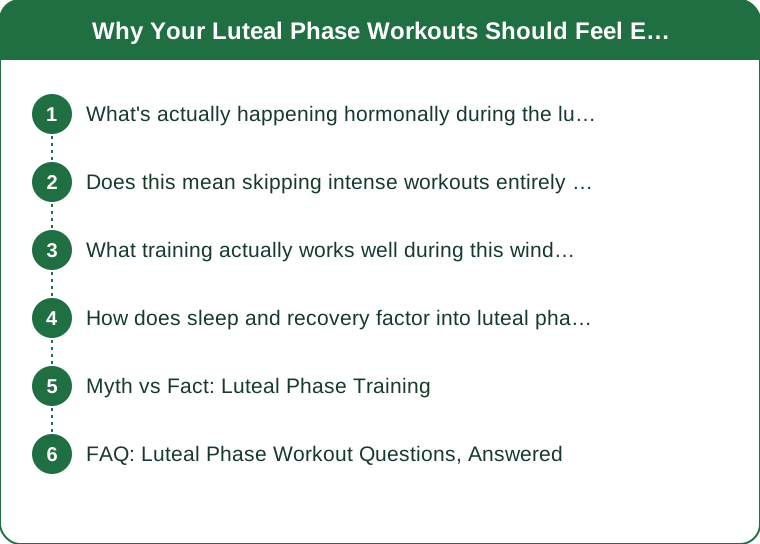
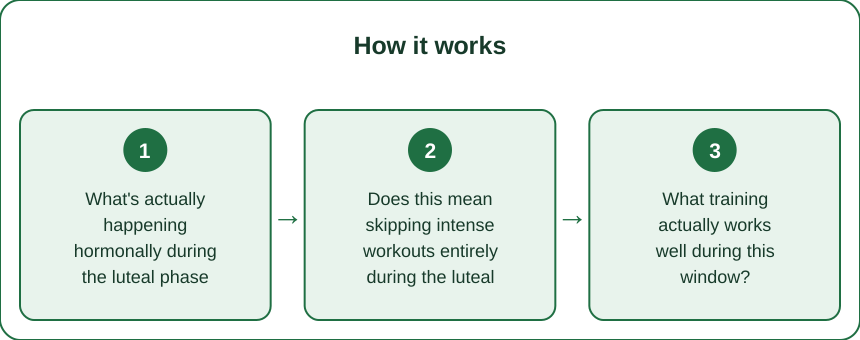
What’s actually happening hormonally during the luteal phase that affects training?
After ovulation, progesterone rises and stays elevated until your period starts, which raises your resting core body temperature by roughly 0.3-0.5°C. That small shift narrows your margin before you hit your heat ceiling during hard efforts, which is a big part of why the exact same interval session can feel noticeably harder in week three or four of your cycle than it did in week one.
Does this mean skipping intense workouts entirely during the luteal phase?
Not necessarily — some people genuinely feel fine and can keep pushing hard, and that’s worth honoring too. But for most people, swapping 1-2 of the week’s hardest sessions for moderate-intensity strength work or steady-state cardio, while keeping easier sessions as usual, reduces the mismatch between effort and how recovered you actually feel.
What training actually works well during this window?
Moderate-load strength training (think 65-75% of your max, 3 sets of 8-10) tends to feel more sustainable than max-effort lifts or all-out sprint intervals. Steady cardio at a conversational pace for 30-40 minutes also tends to sit better than short, brutal intervals, since it doesn’t spike core temperature as sharply.

How does sleep and recovery factor into luteal phase training?
Progesterone’s temperature-raising effect can also disrupt deep sleep slightly, which compounds the training fatigue — you’re often starting the workout a bit less recovered than you’d be earlier in your cycle, which is one more reason a slightly lighter intensity target makes sense here rather than being a cop-out.
Myth vs Fact: Luteal Phase Training
Myth: Cycle syncing means avoiding all hard workouts for two weeks straight. Fact: it’s a modest intensity dial-down (20-30%), not a full stop — plenty of moderate and even some harder sessions still fit fine.
Myth: If a workout feels harder, you’re just out of shape. Fact: a measurable, hormone-driven temperature shift is a real physiological reason effort perception changes, independent of fitness level.
Myth: Every person’s luteal phase symptoms are the same. Fact: some people notice almost nothing; syncing training to your own cycle means tracking your actual response, not applying someone else’s rulebook.
FAQ: Luteal Phase Workout Questions, Answered
Should I still do cardio at all during my luteal phase?
Yes — steady-state cardio at a comfortable pace is usually one of the better-tolerated options during this window, it’s specifically the very high-intensity interval work that tends to feel disproportionately hard.
How do I know if I’m someone who needs to adjust intensity?
Track your energy and perceived effort against your cycle app for one full cycle — if the same workout consistently feels harder in the same week each month, that’s your signal to adjust proactively next time.
Does cycle syncing training actually improve long-term results?
There’s limited large-scale research, but anecdotally many people report better consistency and fewer skipped sessions when training matches how they actually feel, which itself supports better long-term adherence.
TL;DR:
- Progesterone raises resting body temperature during the luteal phase, which can make hard intervals feel disproportionately tough
- Dropping intensity by about 20-30% for your hardest 1-2 sessions a week tends to feel more sustainable
- Moderate strength training and steady cardio are usually well-tolerated during this window
- Sleep disruption from the same hormone shift compounds the effect, so recovery matters more here too
Next luteal phase, try swapping one HIIT session for a moderate strength day and see if the week feels different.
Keep Reading
This article is for general informational purposes only and is not medical advice. Always consult a qualified health professional for guidance specific to you.