Joint Laxity Changes Across Your Cycle - What That Means for Landing
Quick Answer: Estrogen increases ligament laxity, and it peaks in the late follicular and ovulatory window - roughly the few days before and around ovulation. Measured knee laxity is modestly higher then, and epidemiological data shows non-contact knee injuries cluster in that same window. The practical response is not to avoid training, but to prioritize landing mechanics and neuromuscular control work year-round and pay extra attention to it during those days.
This is the one cycle-related effect with a genuinely plausible injury mechanism behind it, and it is also the most misreported.

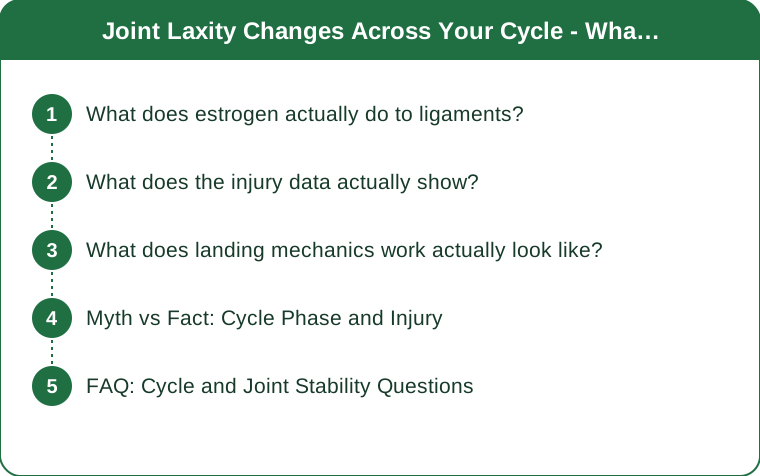
What does estrogen actually do to ligaments?
It changes the mechanical properties of collagen-based tissue, though less dramatically than headlines suggest.
Ligaments contain estrogen receptors, and estrogen influences collagen synthesis and cross-linking. Higher estrogen concentrations are associated with reduced collagen synthesis and lower tissue stiffness.
Measured effects on knee laxity across the cycle are real but modest - studies using instrumented arthrometers typically find differences on the order of a fraction of a millimeter to about one millimeter of additional anterior tibial translation in the ovulatory window compared to the early follicular phase.
A millimeter sounds trivial. The reason it may matter is that ligament behavior interacts with neuromuscular control, and small changes in passive restraint mean the active system - your muscles - has to do slightly more.
There is also a timing lag. Estrogen peaks just before ovulation, but the tissue response appears to lag by roughly 24 to 72 hours, so the highest laxity is often measured slightly after the hormonal peak rather than exactly at it.
What this is not: evidence that you are fragile for a week every month. The effect sizes are small, and the vast majority of training in that window is entirely uneventful.
What does the injury data actually show?
A consistent but modest clustering, and it is worth being precise about what the studies do and do not say.
Multiple retrospective studies of non-contact ACL injuries in female athletes have found injuries over-represented in the pre-ovulatory and ovulatory phase relative to the luteal phase. The effect appears across several sports and several research groups, which is reasonably good evidence that it is real.
But the important caveats: these are mostly retrospective studies relying on recalled cycle dates, the sample sizes for any single study are small because ACL injuries are relatively rare events, and the overall absolute risk in any given window remains low.
What the data does not support: avoiding jumping, cutting, or sport during that window. Detraining has its own injury cost, and reducing exposure to landing practice makes landing mechanics worse over time.
What it does support: treating neuromuscular training as a year-round priority rather than an afterthought, since that is the intervention with the strongest evidence behind it regardless of cycle phase. Structured neuromuscular training programs have been shown to reduce non-contact knee injury rates substantially in female athletes - a far larger effect than anything cycle timing offers.

What does landing mechanics work actually look like?
Three elements, and they take about ten minutes twice a week.
Deceleration practice. Step-downs from a low box, landing softly on one leg with the knee tracking over the middle of the foot. Three sets of 6 to 8 per side, focusing on a quiet landing. Noise is the simplest feedback available - a loud landing means you absorbed it through the joint rather than the muscle.
Hip strength, especially abduction and external rotation. Weak hip abductors allow the knee to collapse inward on landing, which is the mechanism in most non-contact knee injuries. Side-lying abduction, banded lateral walks, and single-leg Romanian deadlifts all target it. Two sets of 12 to 15.
Change of direction drills at controlled speed. Cutting mechanics are trainable. Practicing a planned cut at 70 percent speed, with attention to keeping the knee out and the trunk upright, builds the pattern you default to when it happens unplanned.
The key principle: train the pattern before you need it under fatigue. Most non-contact injuries happen late in a session or a match, when control has degraded. Ten minutes of quality work early in a session builds a better default than any amount of caution.
This is general information, not medical advice - if you have a history of knee injury, this is worth building with a physiotherapist.
Myth vs Fact: Cycle Phase and Injury
Myth: You should avoid plyometrics and sport around ovulation.
Fact: No sports medicine body recommends this, and the cost of reduced training is real. The evidence supports better preparation, not avoidance.
Myth: Hormonal birth control eliminates the risk.
Fact: Some studies suggest a modestly lower injury rate in hormonal contraceptive users, consistent with more stable hormone levels, but the evidence is mixed and it is not a reason to start or stop contraception. That is a decision for you and your doctor on other grounds entirely.
Myth: The laxity difference is large enough to feel.
Fact: Around a millimeter is well below conscious detection. If your knee feels unstable, that is a clinical symptom worth investigating, not a cycle effect.
Myth: This only matters for elite athletes.
Fact: Non-contact knee injuries happen in recreational sport constantly - pickup basketball, netball, skiing, recreational soccer. The neuromuscular training that reduces them is worth doing at any level, and most people have never done any of it.
Myth: Warming up longer is enough.
Fact: A general warm-up raises tissue temperature but does not train landing patterns. A warm-up that includes specific deceleration and hip work does both, which is why structured warm-up programs outperform generic ones.
FAQ: Cycle and Joint Stability Questions
How would I know when I am in that window?
Ovulation is roughly 12 to 14 days before your next period, not necessarily day 14. Ovulation predictor tests, a temperature rise, or cervical mucus changes all give a more accurate marker than counting forward from day 1.
Does this apply to other joints?
Estrogen receptors are present in ligaments throughout the body, and shoulder and ankle laxity changes have been measured too. The knee gets the attention because ACL injuries are common, costly, and heavily studied - not because it is uniquely affected.
Should I change my lifting in that window?
There is no good evidence that heavy lifting is riskier then - controlled barbell movements are not the mechanism in question. The relevant activities are unplanned landing, cutting, and pivoting. Keep lifting normally.
This is general information, not medical advice.
TL;DR:
- Estrogen reduces ligament stiffness, and measured knee laxity is modestly higher - about a millimeter - in the pre-ovulatory and ovulatory window.
- Non-contact knee injuries do cluster in that window across several studies, but the absolute risk stays low and the data is mostly retrospective.
- The evidence supports better preparation, not avoiding training - detraining carries its own injury cost.
- Ten minutes twice a week of deceleration practice, hip abduction and external rotation work, and controlled cutting drills is the intervention with real evidence behind it.
- Heavy lifting is not the risk activity; unplanned landing, cutting, and pivoting are.
Quiet landings are the simplest feedback you have - if you can hear it, you absorbed it through the joint. This is general information, not medical advice.
Keep Reading
This article is for general informational purposes only and is not medical advice. Always consult a qualified health professional for guidance specific to you.